
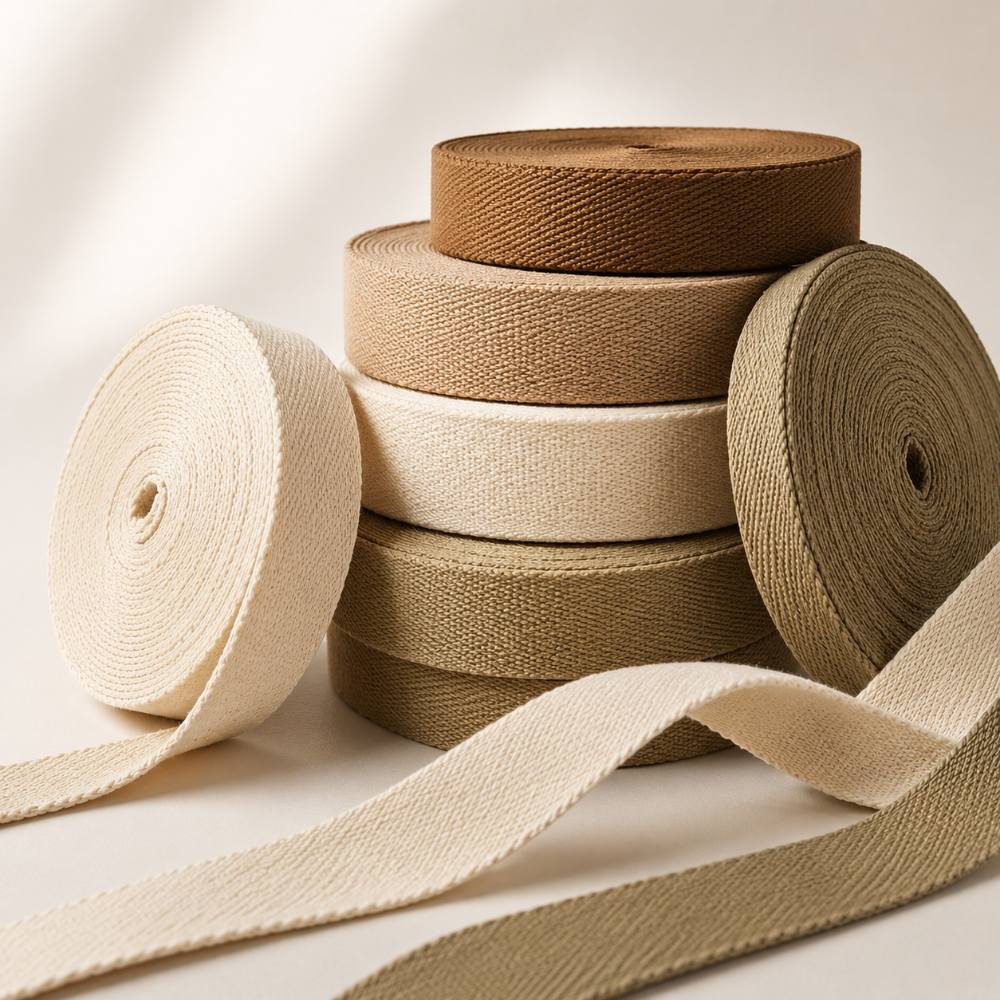
Specifying webbing by appearance alone is one of the most common causes of product failure. Two tapes of the same width and colour can differ substantially in breaking strength and elongation, and the right choice depends on how the load will be applied rather than on how the tape looks.
Breaking strength is the force at which the tape fails when pulled along its length. It is measured in kilograms or kilonewtons and is normally quoted for a standard 25 mm or 50 mm width so that different constructions can be compared. Because strength scales with the number of load-bearing yarns, a wider or denser tape is not automatically stronger: yarn type and weave density matter just as much.
Working load limit is a separate figure and is normally set at a fraction of breaking strength, commonly one quarter to one fifth for safety-critical applications. Any webbing used for lifting, load restraint or fall protection should carry a stated working load limit that already accounts for wear, knots, ageing and dynamic loading. Relying on the breaking strength as though it were a safe working figure is a frequent and costly mistake.
Elongation is measured as a percentage increase in length at a given load. Low-elongation tapes, typically under 5 percent, suit applications where the tape must hold a dimension steady, such as strapping in luggage, harnesses and industrial tie-downs. Higher-elongation tapes absorb shock and are better for pet leashes, cargo nets and applications where a sudden jerk must be cushioned rather than transmitted.
Aramid and UHMWPE cords and webbings sit at the high-performance end. Aramid offers very high strength with low stretch and excellent heat resistance, making it suitable for firefighting, aerospace and industrial slings. UHMWPE gives outstanding strength-to-weight ratio and very high abrasion resistance but has a lower melting point, so it suits marine and cut-resistant applications more than hot environments. Both are considerably more expensive than polyester or nylon and should be specified only where the performance is genuinely required.
For apparel and bag webbing, strength is rarely the limiting factor, but abrasion resistance and colour stability usually are. Polyester webbing is the standard choice for shoulder straps and handles because it balances strength, durability and cost. Cotton webbing is softer and offers a natural look for tote bags and garment trims, at the cost of lower wet strength.
When requesting a quotation, state the application, the expected load, whether the load is static or dynamic, and whether the tape will be exposed to moisture, sunlight or chemicals. A supplier who understands the end use can recommend a construction and a safety factor instead of simply matching a colour and a width.