
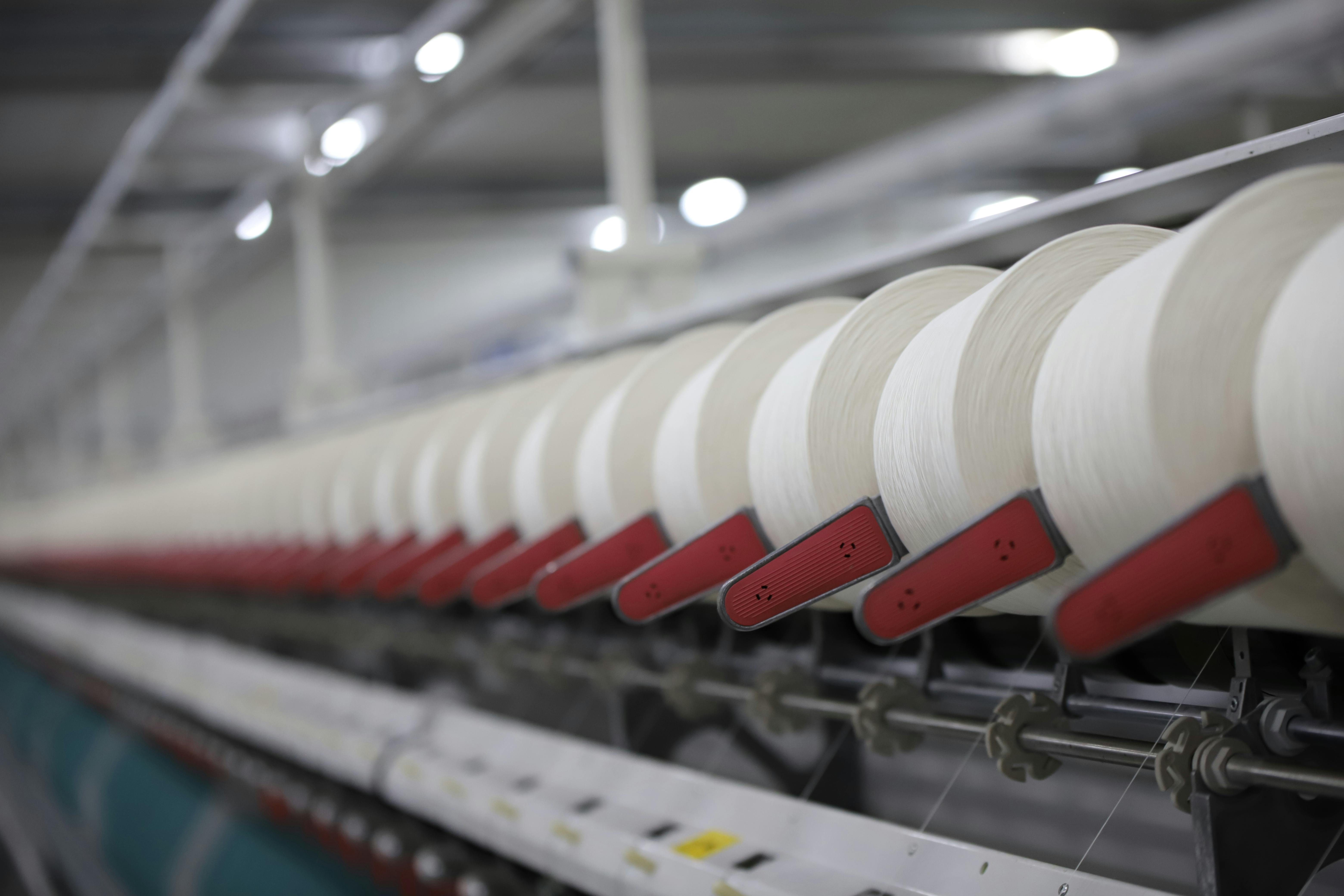
Material is the first decision in any webbing specification, and the one that is hardest to change later. It determines the strength-to-weight ratio, how the tape behaves after washing, how it ages under UV, what it costs, and which compliance documents you can supply to your own customers. This FAQ answers the material questions buyers raise most often when specifying webbing for bags, garments, pet products and industrial applications.
About us: Guangzhou Guanyu Weaving Co., Ltd. is a professional webbing manufacturer in Shiling Town, Huadu District, Guangzhou. With 60+ weaving machines and a monthly capacity of over 130 tons, we produce PP, nylon-like, mesh, polyester-cotton, embossed, printed and jacquard webbing, plus custom woven tapes and RPET options.
In this article
- What webbing materials are available, and how do they differ?
- How do I choose a material for my product?
- When is PP webbing the right choice?
- When is nylon or nylon-like webbing worth the premium?
- What is polyester webbing best for?
- Is RPET recycled webbing a like-for-like substitute?
- What about cotton, elastic, aramid and UHMWPE?
- What compliance documents should I request?
- What information do I need to give a supplier?
What webbing materials are available, and how do they differ?
Six material families cover the overwhelming majority of webbing applications. They are not interchangeable — the differences below are the ones that show up in finished goods.
| Material | Strength | Water & rot | UV / light | Softness | Typical cost | Best for |
|---|---|---|---|---|---|---|
| PP (polypropylene) | Moderate | Excellent — does not absorb water | Fair — degrades under prolonged UV | Firm | Lowest | Bags, packaging, strapping, budget programmes |
| Nylon | Highest of the common three | Good when coated | Good | Softer, better drape | Highest of the common three | Outdoor gear, load-bearing straps, premium handles |
| Polyester | High | Excellent | Excellent | Firm, crisp | Mid | Outdoor and marine, high-visibility, long-life programmes |
| RPET (recycled PET) | Comparable to virgin polyester | Excellent | Excellent | Firm | Slight premium | Sustainability-led ranges, brand ESG commitments |
| Cotton / poly-cotton | Low to moderate | Poor — absorbs water, can rot | Poor — fades | Very soft | Mid to high | Fashion trims, garment detailing, tote handles |
| Elastic | Application-specific | Varies by yarn | Varies | Stretch | Mid | Waistbands, adjustable straps, snug-fit applications |
The single most common specification error is choosing PP for an application that lives outdoors in sunlight, then discovering the tape has embrittled within a season. PP is excellent value indoors and for dry environments — it is a poor choice for permanent outdoor exposure.
How do I choose a material for my product?
Work through the five questions below in order. The first question that produces a hard constraint usually decides the material on its own.
| # | Question | What it rules in or out |
|---|---|---|
| 1 | Will the product be used outdoors or exposed to UV? | Rules out uncoated PP for permanent outdoor use; points to polyester or treated nylon |
| 2 | Will it get wet, or be washed repeatedly? | Rules out cotton and poly-cotton; favours PP, polyester and RPET |
| 3 | What load must it carry, and with what safety factor? | Sets the required breaking strength and therefore the material and width |
| 4 | Does it touch skin or a pet directly? | Favours softer nylon over firm PP; drives comfort and abrasion considerations |
| 5 | Are there sustainability or compliance commitments to meet? | Points to RPET or certified virgin material, with the matching documentation |
Once these five are answered, the remaining variables — width, thickness, colour and finish — are a specification exercise rather than a materials decision. Answering material first avoids the expensive scenario of a colour already matched and a sample already approved on the wrong substrate.
When is PP webbing the right choice?
PP is the workhorse material of bag and luggage manufacturing. It is the most economical option, it does not absorb water, and it resists the mould and rot that affect cotton in humid climates.
| Advantage | Practical consequence |
|---|---|
| Lowest cost per metre | Material cost is the dominant driver of webbing unit price — PP gives the most margin headroom |
| Zero water absorption | Dimensions stay stable when wet; no swelling, no mildew, no weight gain |
| Good chemical resistance | Suits packaging and industrial strapping where contact with detergents or oils is possible |
| Wide colour range | Colour matching to brand references is straightforward |
| Limitation | When it becomes a problem |
|---|---|
| Degrades under prolonged UV exposure | Permanently outdoor applications — tie-downs, garden furniture, marine use |
| Lower melting point | Processes involving high-temperature contact or ironing during finishing |
| Firmer hand than nylon | Direct-skin or pet-contact products where softness affects perceived quality |
| Lower abrasion resistance than nylon | High-wear points such as adjuster buckles that see constant friction |
Rule of thumb: if the product is used indoors or in dry conditions, PP is usually the correct commercial choice. If it lives outdoors in sunlight or must resist repeated abrasion at high load, step up to polyester or nylon.
When is nylon or nylon-like webbing worth the premium?
Nylon is the strongest of the three common materials and has the best drape. It is worth the premium in three situations: where load is high, where the tape must feel soft, or where the product is judged on premium perception.
| Situation | Why nylon wins |
|---|---|
| Load-bearing straps | Highest tensile strength of the common materials, with good elongation for shock absorption |
| Outdoor and climbing-adjacent gear | Better UV performance and abrasion resistance than PP |
| Pet leashes and comfort harnesses | Softer hand reduces chafing, which is a real product-quality differentiator in the pet category |
| Premium bag handles and trims | Smoother finish and better drape produce a higher perceived quality at retail |
On "nylon-like" webbing: this is a distinct, widely used category in the Guangzhou manufacturing cluster. It is engineered to reproduce the appearance and feel of nylon using more economical yarn constructions, and it sits between PP and true nylon on cost. It is a legitimate choice for bags and luggage handles where a nylon look is required but the load case does not demand true nylon strength. Be explicit about which of the two you are buying — the terms are close enough that a specification can be misread.
What is polyester webbing best for?
Polyester is the best all-round outdoor material of the common three. It combines high strength with excellent UV and water resistance, and it holds colour better than nylon under prolonged light exposure.
| Property | Polyester behaviour | Why it matters |
|---|---|---|
| UV resistance | Excellent — retains strength under long sun exposure | The key advantage over PP for outdoor products |
| Water resistance | Excellent — low moisture regain | No swelling; suitable for marine and wet environments |
| Colour retention | Good to excellent | High-visibility and branded colour ranges stay on-brief for longer |
| Strength | High — below nylon, above PP | Adequate for most heavy-duty applications at a lower cost than nylon |
| Hand | Firm and crisp | Gives structure to straps; less suitable where a soft drape is required |
Polyester versus nylon in one line: choose polyester when the product will be exposed to sun and water and needs colour stability; choose nylon when maximum strength and softness matter more than UV life.
Is RPET recycled webbing a like-for-like substitute?
For most bag, luggage and packaging applications, yes. RPET webbing is produced from recycled PET sources and performs close to virgin polyester on the properties that matter in these products: strength, water resistance and UV behaviour.
| Consideration | What to verify before switching |
|---|---|
| Performance parity | Request tensile and elongation data for the RPET construction and compare against your current virgin specification directly |
| Colour consistency | Recycled feedstock can introduce slight batch variation. Confirm colour-matching tolerances and ask for batch samples |
| Certification chain | Ask which certification applies (for example GRS) and whether a transaction certificate can be issued for your order |
| Cost impact | Expect a modest premium over virgin polyester. Model it against the commercial value of the sustainability claim |
| Availability by construction | Not every weave, width or finish is available in RPET. Confirm the specific construction rather than assuming the range is complete |
The compliance principle: a recycled claim is only as strong as the documentation behind it. Before you build a marketing message on recycled content, confirm in writing that the certificates your customer's market requires will be issued for your specific order — not simply that the supplier offers recycled material.
What about cotton, elastic, aramid and UHMWPE?
| Material | What it is | Where it is used | Practical caution |
|---|---|---|---|
| Cotton / poly-cotton | Natural or blended fibre tape | Fashion trims, garment detailing, tote handles, craft applications | Absorbs water; susceptible to rot and fading. Specify the wash and light performance you need |
| Elastic webbing | Knitted or woven with elastomeric yarn | Waistbands, adjustable straps, snug-fit products | Performance depends on the elastic yarn and the recovery specification, not just the width |
| Aramid (e.g. para-aramid) | High-modulus technical fibre | Heat-resistant and high-strength cordage and webbing | Significant cost step. Justify against a genuine load or temperature requirement |
| UHMWPE | Ultra-high-molecular-weight polyethylene | Very high strength-to-weight cordage and webbing | Excellent strength per gram; specify the load case precisely, as cost is high |
These are specialty materials, and the correct approach is to specify them from a defined performance requirement rather than from a catalogue preference. Bring the load, temperature or weight constraint you are solving for, and the construction can be proposed against it.
What compliance documents should I request?
Documentation requirements depend on your destination market and on what your own customer is obliged to prove. The following is the checklist buyers most commonly need.
| Document / standard | What it covers | When you need it |
|---|---|---|
| GRS (Global Recycled Standard) | Chain of custody and recycled content for RPET ranges | When recycled content is claimed in your marketing or by your customer |
| REACH | EU regulation on restricted chemical substances | Any product placed on the EU market |
| OEKO-TEX | Tested for harmful substances in textiles | Products in skin contact — garments, pet products, handles |
| Phthalate and heavy metal testing | Restricted substances in the finished article | Children's products and markets with specific limits |
| Colour fastness test reports | Performance under washing, rubbing and light | Any product where fading would trigger a claim |
| Tensile and elongation test data | Breaking strength and stretch of the construction | Load-bearing applications and any safety-related use |
| Technical data sheet | Width, thickness, weight, composition and tolerances | Every order — this is the baseline specification record |
Ask before you quote, not after you ship. Confirm which documents the supplier can issue for your specific construction and destination market. A capability that exists on a general datasheet may not apply to the particular weave or finish you ordered.
What information do I need to give a supplier?
A complete brief is the single most effective way to shorten sampling time. Suppliers can develop a quotation from a photograph, but they can only develop the correct product from the information below.
| # | Information | Why it matters |
|---|---|---|
| 1 | Material | Drives strength, cost and compliance route |
| 2 | Width and thickness | Determines hand, stitchability and hardware compatibility |
| 3 | Colour reference | A physical standard or a recognised colour code, not a screen image |
| 4 | Breaking strength requirement | Allows the correct construction to be engineered rather than guessed |
| 5 | Surface finish | Plain, embossed, printed, jacquard or mesh — affects tooling and development time |
| 6 | Edge finish | Hot cut, woven or stitched edge; affects fraying and assembly |
| 7 | Application and end use | Lets the supplier flag risks you may not have considered |
| 8 | Quantity and packaging | Enables accurate pricing and lead-time planning |
| 9 | Compliance requirements | Determines whether the construction and documentation route is viable |
Related reading on this site
Specifying webbing for a new programme?
Send us your material requirement, width, colour reference and target load. We produce PP, nylon-like, polyester, RPET, cotton and elastic webbing on 60+ machines with a monthly capacity of 130+ tons, and can advise on the construction that fits your application.
This FAQ addresses material selection questions from buyers specifying webbing. Compliance requirements differ by market — always confirm the specific regulations and documentation that apply to your destination and to your own customer obligations.