
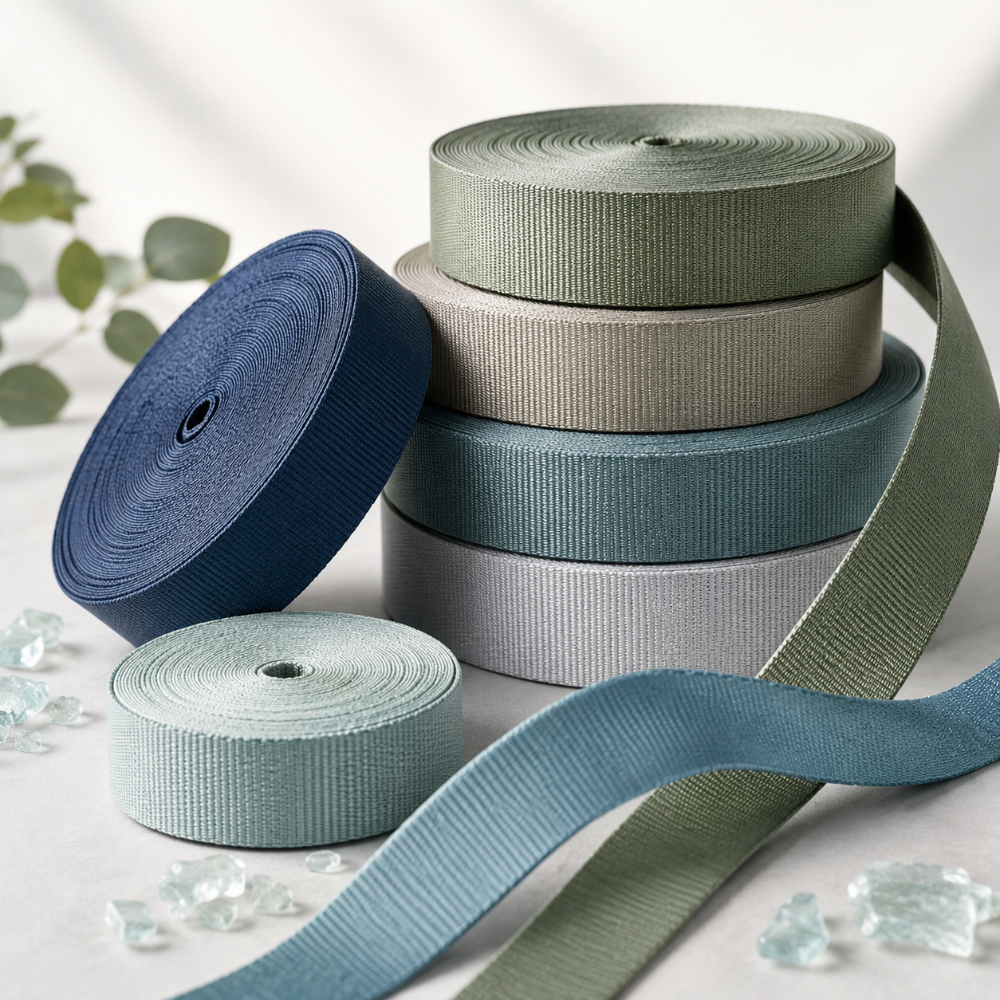
Webbing is rarely used on its own. It is stitched into a bag, threaded through a buckle, sewn under a presser foot and folded around a seam. Each of these operations places demands on the tape that are not visible in a simple width and colour specification. Sizing a tape correctly for assembly is one of the most practical ways to avoid production delays.
Width tolerance is the first consideration. Woven webbing is normally supplied with a tolerance of plus or minus 1 mm, which is acceptable for most bag and garment applications. However, hardware has its own tolerances. A buckle designed for 25 mm webbing may be manufactured to accept anything from 24.5 mm to 25.5 mm, and if the tape and the hardware sit at opposite ends of their ranges, threading becomes difficult or the tape slips.
The practical solution is to specify both the tape width and the hardware together, and to request samples of both before committing to bulk. Where a tight fit matters, a slightly undersized tape threads more easily than an oversized one, because the buckle itself limits lateral movement.
Thickness affects sewing more than most buyers expect. Heavier webbing requires a larger needle, a longer stitch length and more pressure from the presser foot. Layers add up quickly: a folded strap, a lining and a binding tape can combine to a thickness that a standard domestic-type machine cannot handle reliably. Industrial machines with walking feet manage thick assemblies better, but the design should still avoid unnecessary layer stacking where possible.
Edge finish is closely related. A hot-cut or ultrasonic-cut edge seals thermoplastic fibres such as polyester, nylon and PP, preventing fraying. A woven or taped edge looks cleaner but frays when cut, so it is usually reserved for applications where the raw edge is hidden inside a seam. For tapes that will be cut and used with exposed ends, requesting a sealed edge removes a common source of complaints.
Stitch density matters as well. Too few stitches per centimetre and the seam can pull open under load; too many and the needle perforates the tape, weakening it rather than reinforcing it. Eight to ten stitches per inch is a common starting point for medium-weight polyester webbing, adjusted for tape weight and thread type.
Finally, consider how the tape behaves when wet or stretched. Some webbing shrinks slightly after washing, and PP tapes can stiffen in cold conditions. Where a finished product must hold a precise dimension, requesting pre-shrunk or heat-set webbing avoids surprises after the first wash or after a season in the field.