
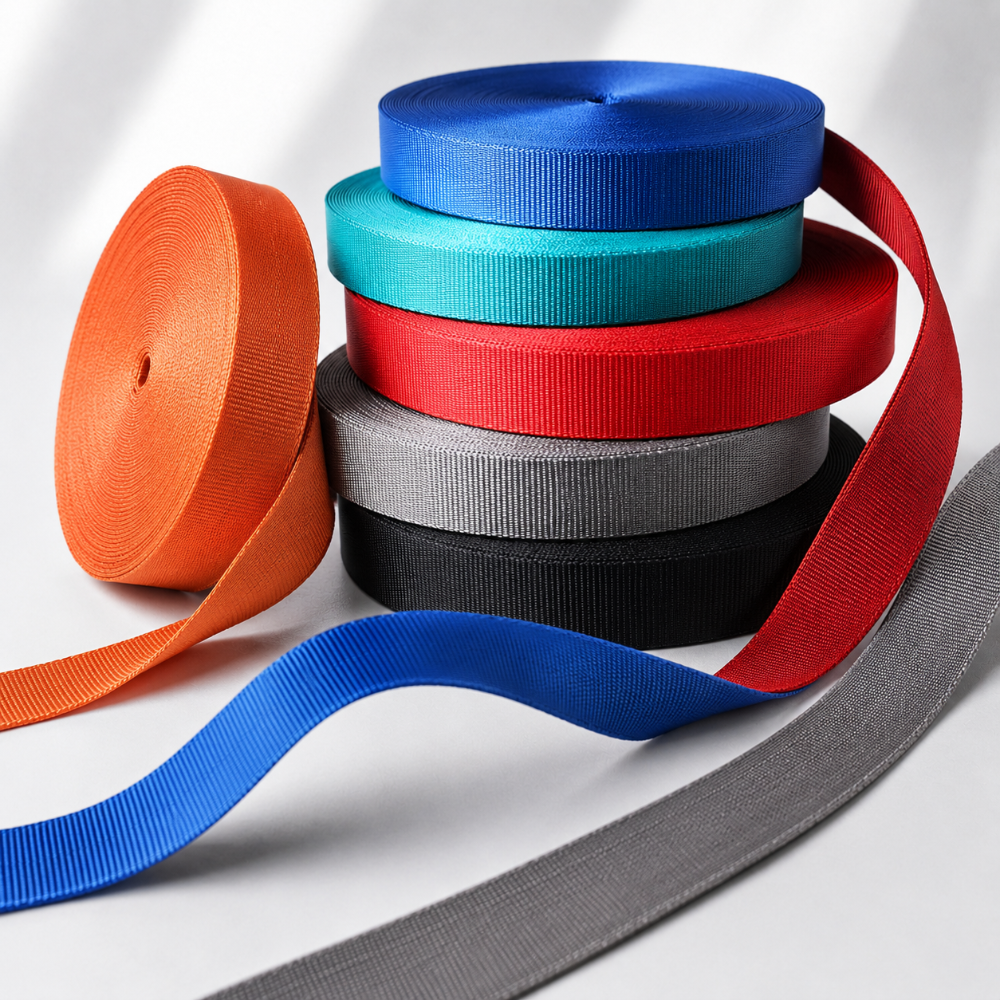
Colour is one of the first things a buyer checks on a webbing sample, and fading is one of the most common complaints once a product has been in use for a season. Colour fastness is not a single property. It depends on the fibre, the dyeing method, the dye class and the finishing process, and understanding how these factors interact makes it far easier to specify a tape that holds its colour in real conditions.
Polypropylene (PP) webbing is solution-dyed, meaning the colour pigment is added to the polymer before the tape is extruded. Because the colour runs through the material rather than sitting on the surface, PP webbing resists fading well and suits outdoor furniture straps, promotional bags and products that are cleaned frequently. The main limitation is colour range, since solution dyeing works best with solid, high-saturation shades.
Polyester and nylon webbing are usually dyed after weaving. Polyester is normally dyed with disperse dyes under high temperature and pressure, which delivers excellent wash fastness and good light fastness. Nylon accepts acid dyes easily and produces very bright, deep shades, but it is more sensitive to UV exposure and can shift tone after long periods of sunlight unless a UV stabiliser is added. For products that stay outdoors, polyester is often the safer choice.
Light fastness is graded from 1 to 8, where 8 means no visible change after prolonged exposure to a standard light source. For bag and garment webbing a rating of 4 or above is normally acceptable, while outdoor, marine and automotive applications should be specified at 6 or higher. Wash fastness is graded separately from 1 to 5, and 4 is a sensible minimum for any textile that will be laundered.
Colour matching is the other half of the problem. When a brand supplies a Pantone reference, the supplier should confirm whether the match is required under daylight, store light or both, because the same dye can appear different under each. Metamerism, where two colours match under one light source but not another, is behind most colour disputes. Providing a physical swatch, or approving a lab dip before bulk dyeing, removes most of this risk.
Practical steps to reduce fading complaints: choose solution-dyed PP wherever the application allows it, specify a light fastness grade instead of assuming a dye will perform, avoid mixing fibres in one product if they will be dyed separately, and request a UV stabiliser for any tape used outdoors. Testing a finished sample under real conditions, rather than relying on a lab report alone, remains the most reliable check.