
For importers and brand owners, webbing quality problems rarely appear on the sample. They appear in the bulk shipment, after hundreds of metres have already been cut and sewn into finished products. A simple quality control routine, agreed with the supplier before production, prevents most of these issues. This article outlines the main points buyers should check.
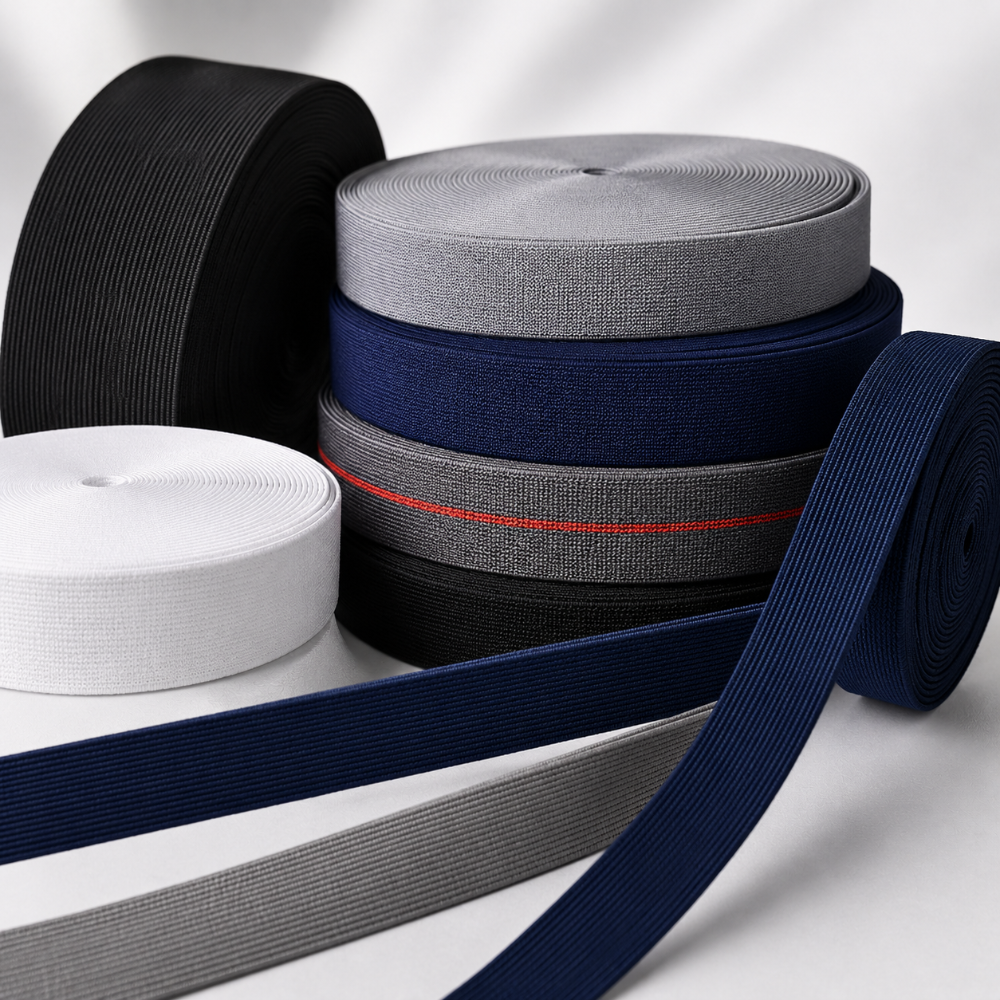
The first check is colour consistency. Dyed webbing should be compared against an approved colour standard under the same lighting conditions. Batch-to-batch variation is common in textile dyeing, so buyers should ask the supplier to keep an approved sample and to dye all production of one order in a single batch where possible. Colour fastness to rubbing, washing and light should also be confirmed, especially for outdoor and garment applications.
The second check is dimensional accuracy. Width and thickness should be measured at several points along each roll, because a tape that drifts outside tolerance will cause problems during automatic cutting and sewing. Buyers should also check the roll length, the number of joints per roll, and whether the tape is wound evenly without twisting or overlapping.
The third check is appearance and structure. Inspectors should look for broken or missing warp ends, weft density variation, uneven edges, oil marks, dye spots and loose threads. For jacquard and printed webbing, the pattern should be checked for sharpness, correct positioning and consistency along the whole roll. A defect limit table is a useful reference, because it defines how many defects per hundred metres are acceptable and at what size.
The fourth check is strength testing. Tensile testing on a sample from each production batch gives a reliable indication of whether the tape meets the agreed breaking strength. For safety-related products, buyers should request test reports and consider third-party inspection before shipment.
Guangzhou Guanyu Weaving Co., Ltd. supplies bag webbing, garment webbing and special webbing to customers in many countries. With stable production equipment, experienced workers and established quality control procedures, the company works with buyers to agree inspection standards before mass production and to keep samples on file for every order.